








Written by
Kathryn Wilson

Upcoming Events
Student Services Information Evening for Year 7 Parents
25 February 7.00pm
The purpose of this evening is to communicate the various academic, social, and environmental supports available at Loyola, and discuss how these may alter as your child grows. This is a parent only session for those with children with an identified individual need.
More information regarding this evening will be provided shortly by our Director of Students Services, Mrs Kelly Hussey.
VCE Evening
26 February 7:00pm. Inigo Theatre - Magis Performing Arts Centre.
The purpose of the evening is to provide an overview of VCE procedures for 2026, in the hope that any concerns or questions you may have will be answered and addressed.
More information regarding this evening will be provided shortly by our Head of VCE, Mr Stephen Brasier.
Year 7 and 9 NAPLAN
Please note that NAPLAN will now take place in the LCH week beginning 9 March. Further details will be available nearer the time.
Dates are:
• Wednesday 11 March: Writing
• Thursday 12 March: Reading
• Friday 13 March: Language Conventions
• Monday 16 March: Numeracy
• Tuesday 17 March: Catch up Session
Session times:
• Year 7: Period 1 each day
• Year 9: Period 3 each day
Assessing Student Curriculum and Assessment Grades – new students to the College
Both students and parents/guardians have access to curriculum material via our Learning Management System. Teaching Staff post course work, homework and resources to help our learners as they travel through this year’s curriculum. It is possible to track student usage, and we aim to support parents to a level of comfort with using the LMS as a means to view what their child is working through in class. Assessment marks will also be placed on the LMS within three weeks of being collected, moderated and marked.
School Assessed Coursework (SACs) are Part of Assessment
As the term progresses student assessment becomes more frequent. It is during this period that students can start to feel the pressure of assessment(s). It is important that we keep in mind what assessment is. Assessment is the opportunity for students and teachers to assess what they have been learning in class and receive important feedback on their strengths and areas for improvement. Assessment only tests or examines what students have already been studying.
At Unit 3/4 level, each SAC is often only worth a small percentage of the total year’s overall assessment, with the majority of the end of year results weighted heavily on examination results.
Some hints to avoid assessment stress:
• Complete all set work
• Complete a regular homework program
• Use your class time well
• Revise consistently
• Attend out of class help sessions, such as master classes held after school
• Meet with your teacher to go over the feedback after SACs/SATs
• Set achievable goals
• Attend Homework Club on a Tuesday/Wednesday after school
• Use the Study Design to guide learning and revision
Students should discuss any concerns that they may have with their subject teacher, mentor or the relevant Student Programs Coordinator.
Immediate S for Units 1- 4 SACs
Students will receive an immediate S for a SAC when they have demonstrated the following:
• Produce work that demonstrates achievement of the outcomes
• Submit work that is clearly their own
• Observe the rules of the Victorian Curriculum and Assessment Authority (VCAA) and the school. (School rules may include for example Attendance or Submission of Work policies)
If any or all of these are not satisfied at the time of the SAC/SAT a student can be awarded a ‘Provisional N’. There are many options to redeem an S for any missed Learning Outcome(s). Students will need to consult with their subject teacher about the best way to proceed.
Study Smarter, Not Harder: Brain-Based Tips for Success
Many parents may have read the recent Herald Sun article ‘Chunk it, switch it, and space it out, but don’t cram - the new brain-based study tips for students’
Experts reveal better study methods than last-minute cramming | Herald Sun
As term time gets underway, students are being encouraged to rethink how they approach study, with evidence showing that how you study can matter just as much as how long. Recent education insights highlight three powerful strategies: chunk it, switch it, and space it out and remind us of one thing to avoid: don’t cram.
Chunk it involves breaking learning into smaller, manageable sections. This helps reduce cognitive overload and improves understanding and recall.
Switch it encourages students to vary topics or question types within a study session. This approach strengthens connections in the brain and improves long-term retention.
Space it out refers to spreading study across time. Revisiting material over days or weeks is far more effective than trying to learn everything at once.
Importantly, the research reminds us of one key principle: avoid cramming. While it may feel productive, cramming often increases stress and results in weaker retention.
Encouraging students to adopt these strategies can support deeper learning, improved confidence, and more sustainable study habits.
Being Ready to Learn
A key part of being equipped for learning is developing consistent habits of preparation. Arriving to every lesson ready to learn and engage allows students to maximise their learning time and reduces unnecessary disruptions.
Students are expected to bring their device to school fully charged each day, along with essential learning resources to lessons including a pen, pencil, ruler, and planner. These simple but important routines support organisation, independence, and personal responsibility.
For subjects requiring specialised equipment, students must also ensure these items are ready to use. For example, students studying Mathematics should bring their CAS calculator fully charged. In recent years, the Mathematics Department has provided calculator charging facilities to assist students who occasionally arrived without a charged device. While this was intended as a support measure, it has increasingly become relied upon as a routine service rather than a backup for exceptional circumstances, such as loss, theft, or unexpected malfunction.
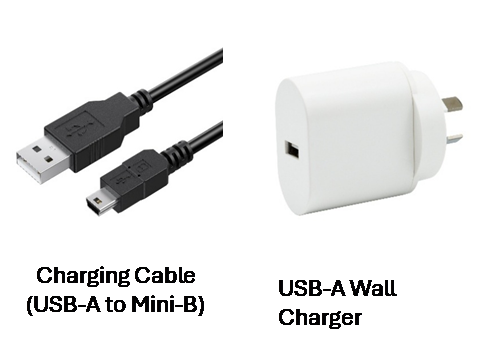
Discontinuing this service is intended to reinforce positive learning habits and strengthen student responsibility. We ask families to support this expectation by ensuring students have access to appropriate charging equipment at home, including a dedicated calculator charging cable (USB-A to Mini-B) and a standard USB-A wall charger. In the spirit of fostering independence and personal responsibility, students are encouraged to treat their device and CAS calculator with the same care and routine preparation as their other essential devices, such as their phone and gaming accessories (please see Mr Green if you have any questions regarding CAS calculator)